

By Irina Perry
Apex 1 Radio hosted a powerful and thought-provoking edition of Apex Anthology on May 24, 2026, featuring poet and author Iggy Mizuh and his third poetry collection, It’s Black It’s White.
Broadcast live across Facebook, YouTube, TuneIn, Radio Garden, and the Apex 1 Radio app, the program brought together literature, journalism, migration stories, social justice, and artistic expression in a moving international discussion connecting audiences from Columbus, Ohio; Toronto, Canada; Victoria; Germany; and the United Kingdom.
Hosted by Earnest Kanjo alongside Tina Naloba, the special edition explored the emotional and intellectual depth behind Mizuh’s latest anthology while highlighting the poet’s unique ability to merge journalism with poetry.
“Poetry will never die,” Tina Naloba stated during the broadcast. “Every passing second creates new stories — stories about humanity, migration, suffering, survival, beauty, and hope. Those stories eventually become poetry.”
The collection, released in 2023, contains approximately 120 poems spanning themes of migration, homelessness, identity, women’s struggles, displacement, social inequality, emotional survival, and the human condition. Throughout the discussion, listeners gained insight not only into the poetic structure of the work, but also into the lived realities and research that inspired it.
Poetry Rooted in Reality
One of the strongest moments of the program came during the discussion of the poem Homeless at Home, which centers around the struggles of a young homeless woman navigating abandonment, hunger, and emotional isolation.
Kanjo noted the intentional use of emotionally charged language throughout the poem, including phrases such as “a slap in the face,” “what a shame,” “what a pity,” and “what a waste,” asking whether Mizuh deliberately selected words designed to provoke anger and emotional discomfort in readers.
Mizuh confirmed that the language was intentionally crafted to force readers to feel both outrage and empathy toward homelessness and social neglect.
The conversation later shifted toward migration and refugee experiences through the emotionally heavy poem Lonely Like an Island, which follows the dangerous migration journey of an individual traveling through deserts, smuggling routes, and deadly sea crossings while chasing the dream of reaching Europe.
The poem paints vivid scenes of migrants enduring the Sahara Desert, exploitation by smugglers, overcrowded vehicles, poverty, survival labor, and ultimately the terrifying uncertainty of Mediterranean Sea crossings.
“It all turned into a terrible dream,” Sharon Jeanette recited during one of the program’s most emotional moments.
Mizuh explained that the poem reflects real migration routes many African migrants travel while attempting to reach Europe, including experiences of extortion, abandonment, border exploitation, and dangerous crossings by sea.
“There is information inside the poetry,” Kanjo reflected during the interview. “This work is not only poetic beauty — it is also deeply informative.”
Journalism Through Poetry
Both hosts repeatedly emphasized how Mizuh’s journalism background strengthens his writing. Tina Naloba described the poet’s ability to transform factual realities into artistic storytelling as one of the collection’s greatest strengths.
“If you are someone whose responsibility is to inform society,” she explained, “you can communicate through journalism, broadcasting, storytelling, or poetry. But first, you must possess the information — and clearly, Iggy does.”
The discussion also explored Mizuh’s writing style and structure, including his deliberate use of recurring questions at the beginning of multiple stanzas, symbolic metaphors, and emotionally layered language.
One particularly discussed phrase, “ground cargo calculations,” sparked conversation about burdens carried by women in society. Mizuh explained that the phrase symbolized emotional and physical weight — comparing women’s daily struggles to carrying heavy cargo while trying to satisfy societal expectations.
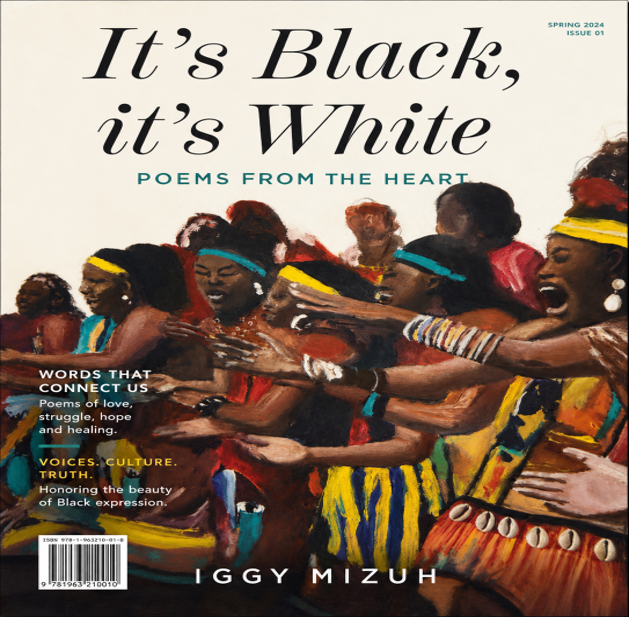
A Cover That Combines Fine Art and Poetry
The interview also highlighted the striking cover art of It’s Black It’s White. Mizuh revealed that the artwork was created in collaboration with a mentor and artist currently based in the United States.
The original painting used for the cover is reportedly valued at approximately $9,000.
In the book’s acknowledgments section, Mizuh thanks the artist Shiri Atto for creating the “captivating front cover painting which combines poetry and fine art.” He also acknowledged Rodney King, Earnest Kanjo, and Sharon Zione for their inspiration and support throughout the creative process.
International Collaboration Through Media
The broadcast itself reflected the international nature of modern media and storytelling.
While Earnest Kanjo hosted from Ohio, Tina Naloba joined from Toronto, Canada, Sharon Jeanette participated from Victoria along the Atlantic coast, and producer Maxel Ajif coordinated the edition from Basel, Germany.
The show also recognized the contributions of Irina Perry, studio director for the program and founder of Perry’s Media Production LLC, who followed the discussion closely throughout the live broadcast.
Literature as a Bridge Between Communities
Throughout the two-hour conversation, It’s Black It’s White emerged as more than simply a poetry collection. It became a reflection of migration, identity, emotional survival, displacement, womanhood, homelessness, and resilience.
Kanjo concluded the program by announcing that this interview would become the first installment in a three-part series dedicated to exploring the anthology more deeply in future broadcasts.
“This collection contains so much information, experience, and reflection,” Kanjo said. “And when the poet himself carries that understanding, the work comes alive.”
It’s Black It’s White by Iggy Mizuh is currently available on Amazon.